Press Release on Rased’s Report on Parliament’s Discussions of the 2024 Audit Bureau Report
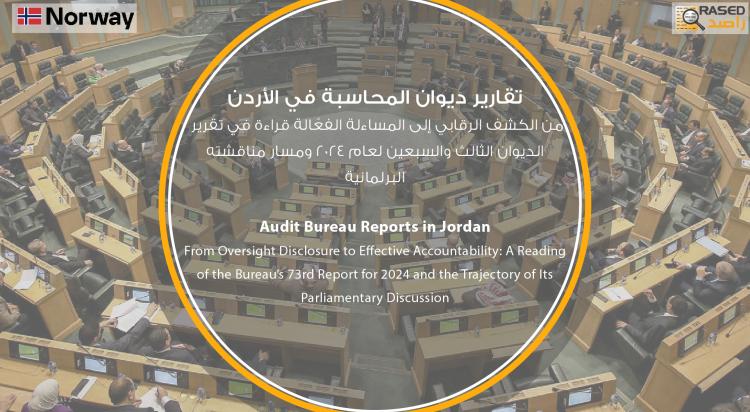
Rased: High-Intensity Oversight with Limited Impact in Parliamentary Discussions of the Audit Bureau Report
Rased Calls on Parliament to Follow Up on the Implementation of Finance Committee Decisions Related to Audit Bureau Reports
Rased: 43 MPs Participated in Finance Committee Meetings Discussing the Audit Bureau Report
Rased: 33% of MPs’ Interventions on the Audit Bureau Report Were Diagnostic
Rased: 21% of MPs Supported the Audit Bureau, While 17% Criticized Its Performance
Amman – Tuesday
An analytical report issued by Al-Hayat Center – Rased on the Jordanian Parliament’s discussions of the Audit Bureau report concluded that the Jordanian case represents a model of “high-intensity, low-impact oversight.” While parliamentary oversight tools for detection and review are available, they are not sufficiently translated into concrete executive outcomes or sustained institutional deterrence, revealing a clear gap in the implementation and follow-up phases.
This conclusion comes within the context of Rased’s analysis of the outputs of the 73rd Audit Bureau Report for 2024 and its discussion within the House of Representatives during its second ordinary session. The report highlights the quality of oversight discussions within the Finance Committee and under the Parliament dome, as well as the challenges associated with the post-decision phase of oversight actions.
The report, alongside a policy brief, is based on a comprehensive analysis of the oversight cycle, starting from the production of outputs by the Audit Bureau, through parliamentary deliberations, and reaching the level of government implementation. It shows that the Audit Bureau conducted 123,369 audit tasks, produced 115 oversight outputs and 1,003 review memoranda, identifying 4,357 violations and achieving direct financial savings of JOD 22.3 million, with a correction rate reaching 59%.
At the parliamentary level, the report found that the Finance Committee constituted the core arena of oversight discussions, holding 36 intensive meetings with the participation of committee members and 43 MPs from outside the committee, in addition to summoning dozens of government entities. The committee ultimately classified 171 oversight outputs and issued clear decisions regarding them, ranging from corrected cases to those under follow-up, as well as cases requiring financial recovery measures or judicial and oversight referrals.
The committee’s discussions were characterized by a detailed technical approach, focusing on case-by-case analysis of violations and addressing key issues such as weak financial recovery. In some cases, the recovery rate did not exceed 4.4% out of JOD 2.463 million, alongside recurring violations and weaknesses in project management. However, the report noted that this technical depth, despite its importance, was not translated into sufficient executive commitment, particularly with many cases remaining “under follow-up” without a clear timeframe for resolution.
In this context, Rased emphasized that weak parliamentary follow-up on Finance Committee decisions after their approval by the House of Representatives is a major factor limiting oversight impact. There are no clear mechanisms to track the implementation of these decisions or to hold government entities accountable, leaving a portion of the observations unaddressed.
The report stressed that the role of Parliament should not stop at discussing the report or approving the committee’s decisions, but should extend to systematically and periodically following up on their implementation to ensure their translation into tangible government actions and to reduce the recurrence of violations.
The report also addressed the shift in the Audit Bureau’s work from ex-ante to ex-post auditing, noting that while this transition is important, it requires strengthening internal control units within government institutions to prevent widening oversight gaps, especially given the persistence of repeated violations and weak deterrence in several cases.
Regarding parliamentary discussions, the report found that 33% of interventions were diagnostic, focusing on analyzing the root causes of issues, while 29% were directed at criticizing government performance, 21% supported the Audit Bureau, and 17% criticized its performance. Despite this diversity and momentum—sometimes supported by numerical indicators such as the low recovery rate of 4.4%—this advanced level of diagnosis did not translate into new oversight tools or binding implementation mechanisms.
The report further noted that, despite the intensity of discussions, they were largely individual and lacked coordination at the parliamentary bloc level. A total of 24 substantive interventions were analyzed, each limited to a maximum of three minutes, resulting in condensed rhetoric at the expense of in-depth analysis. Consequently, the impact of discussions remained largely rhetorical, without producing sustained institutional influence.
In light of these findings, Rased recommended activating the role of parliamentary blocs in dealing with Audit Bureau reports by unifying positions and coordinating oversight discourse. It also called on the Finance Committee to establish a binding timeline for the government to address audit observations, ensuring a transition from classification and discussion to actual implementation, and reducing the number of outputs remaining “under follow-up.”
Rased further urged enhancing public transparency by publishing periodic and transparent follow-up reports on actions taken in response to Audit Bureau observations, thereby strengthening public accountability and increasing the cost of non-compliance.
The report concluded that the challenge is no longer about producing more reports or intensifying discussions, but rather about building a follow-up and implementation system based on obligation and transparency—one capable of transforming oversight outputs into tangible results that enhance spending efficiency and protect public funds.