Rased: Voter Turnout in Amman Chamber of Industry Elections Reaches 53.4%, Compared to 87% in 2022 and 83.5% in 2018
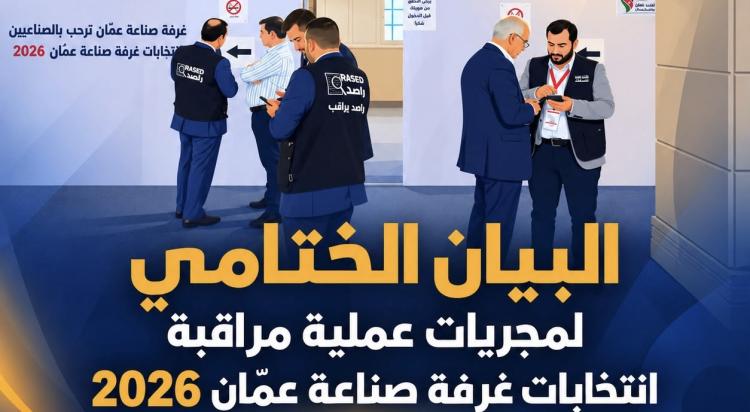
Rased: Voter Turnout in Amman Chamber of Industry Elections Reaches 53.4%, Compared to 87% in 2022 and 83.5% in 2018
Rased: Plastics and Rubber Industries Record the Highest Voter Turnout at 69.9%, While Construction Industries Record the Lowest at 39.8%.
Rased: Smooth Procedures Observed During Amman Chamber of Industry Elections.
Rased Calls for Expanding the Representation of Small and Medium-Sized Enterprises and Strengthening the Developmental Role of Industrial Chambers.
Al-Hayat Center – Rased monitored the elections of the Board of Directors of the Amman Chamber of Industry on Saturday, October 3, 2026, through five monitoring teams. Following the closure of ballot boxes at 7:00 p.m., a total of 640 out of 1,199 eligible voters had cast their ballots, representing a voter turnout of 53.4%.
In comparison with previous election cycles, voter turnout in the Amman Chamber of Industry elections reached approximately 87% in 2022, with 1,014 out of 1,169 eligible voters casting their ballots, compared to 83.5% in 2018, with 1,010 out of 1,209 eligible voters participating.
At the sectoral level, the Plastics and Rubber Industries recorded the highest voter turnout at 69.9%, with 102 out of 146 eligible voters participating. Meanwhile, the Construction Industries recorded the lowest turnout at 39.8%, with 33 out of 83 eligible voters casting their ballots.
The monitoring teams observed smooth procedures and an orderly voting process, with no violations or irregularities recorded within the scope of monitoring during the voting process. The electoral process commenced at 9:00 a.m., following the fulfillment of the legal quorum, with 51.9% of eligible voters registered for the meeting to convene.
Competition in Amman was limited to the Chamber's Board of Directors, with ten candidates contesting nine seats, while sectoral representation was decided by acclamation. The elections of the Irbid and Zarqa Chambers of Industry were also settled by acclamation, as the number of candidates equaled the number of available seats.
Rased conducted a field survey involving 213 respondents who had cast their ballots in Amman. The results showed that 94.8% rated the clarity of ballot paper instructions as excellent, while 97.2% reported that the entire voting process took less than ten minutes, from entering the polling center to leaving it.
Furthermore, 95.8% rated the performance of the Independent Election Commission as excellent, while 89.7% expressed a very high level of confidence in the integrity of the elections. Additionally, 85% reported having a very high level of confidence that the vote-counting process and the announcement of results would accurately reflect voters' choices.
When asked about the primary reason for selecting their preferred candidates, 40.4% identified experience and competence as the main factor, followed by previous performance within the Chamber at 40%. Meanwhile, 8.5% cited the proposed program for serving the industrial sector.
Regarding expectations of the elected Chamber's ability to represent the needs of their establishments, 54% of respondents expected it to do so to a very great extent, while 29.6% expected it to do so to a great extent.
When asked about their expectations for their establishments' business activity over the coming year, 54.5% of industrialists anticipated an expansion in their business activities, while 37.6% expected their activity to remain at its current level. Meanwhile, 6.1% anticipated a contraction, and 1.9% were unable to make a prediction.
Rased called for a review and amendment of the Law on Chambers of Industry, as well as the regulations and instructions issued pursuant to it, to broaden the participation of small and medium-sized industrial enterprises and ensure their effective representation on chamber boards of directors and within sectoral representation structures.
The proposed review should address membership, voting and candidacy requirements, as well as representation mechanisms, in a manner that enables these enterprises to play a greater role in setting priorities and shaping decisions, given their importance as a fundamental pillar of Jordan's economy, production, employment and local development.
Rased also called on industrial chambers to develop a strategic vision for each industrial sector in partnership with establishments of all sizes, in alignment with the Economic Modernization Vision.
These strategies should include measurable objectives to increase production, exports and employment, while addressing challenges related to energy, financing, skills and market access. They should also include the publication of periodic progress reports and the strengthening of dialogue with the government to follow up on responses to the sector's priorities.
It is worth noting that the vote-counting process began immediately after the ballot boxes were closed.